

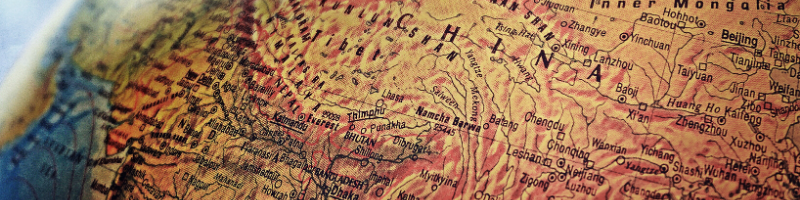
 Just about everyone is familiar with those "mysterious lines" on maps and globes representing latitude and longitude. They form a grid system by which any spot on Earth can be precisely pinpointed -- and there's nothing mysterious or difficult about it.
Two locations on Earth are determined by its rotation -- the North and South Poles. This is where the imaginary axis upon which our planet turns passes through its surface; on some globes the axis is an actual rod. The North Pole is in the middle of the Arctic Ocean at a spot which is usually frozen over with sea ice so that explorers have been able to reach it by dog sled. However, since the ice slowly moves, the North Pole is a mathematical rather than actual point. The South Pole, on the other hand, has a permanent physical location in the interior of the huge island continent of Antarctica, which has also been reached by overland explorers. Today, both poles are easily reached by aircraft, and some commercial flights regularly fly over the North Pole, such as those flights between Alaska and Europe.
Halfway, between the poles is a large circle at the "waist" of the Earth, which on the globe is represented by the seam joining its northern and southern hemispheres; this circle is the Equator. This forms the zero-degree latitude circle. Running parallel to the equator above and below it are other latitude circles numbered in degrees; on the globe -- as on many maps -- these circles are indicated for each 15. Latitude extends in degrees north and south of the Equator with the poles being 90. Above the Equator it is called north latitude, while below it we have south latitude. (Navigators and map makers often label north and south latitudes with plus and minus signs.) Circles of latitude are called parallels, since they run parallel to the Equator. On our globe is the latitude circles are labeled along the 180 longitude (vertical) circle in the middle of the Pacific Ocean.
While the north-south coordinate system -- or latitude -- is "anchored" by the Earth's rotation, the system for indicating east and west, or longitude, is not that simple. There is no "natural" place like the Equator to place its zero point. In the late 19th Century it was decided by international agreement that the zero circle of longitude should run through the Greenwich Observatory in England (which is an eastern London suburb) because this observatory has, since the late 17th Century, been a leading source of data used by navigators.
Circles of longitude are called meridians, and that which runs through Greenwich -- 0 -- is called the Prime Meridian (or sometimes Greenwich Meridian). Longitude is numbered in degrees east and west of the prime meridian all the way around to the meridian in the Pacific Ocean directly opposite Greenwich, which is labeled 180. Longitude values east of Greenwich are called east longitude; the other way is west longitude. Since all longitude circles meet at the poles, these two locations have no longitude value -- only latitude. On the globe, as also on many maps, every 15 longitude circle is shown and labeled; these labels can usually be found along the globe's Equator.
Next: The International Date Line
Jump to other articles on subject:
Introduction to Artline Globes
Tropics and Climate Zones
The "China Syndrome" Myth

