



 Born in Richland Center, Wisconsin in 1867, Frank Lloyd Wright (June 8, 1867 April 9, 1959) was an American architect, interior designer, and educator who designed more than 1,000 projects in his lifetime, turning more than 500 of those into completed works. In 1940, he established The Frank Lloyd Wright Foundation to protect, preserve and administer his lifes work. In 1991, Architectural Record magazine published a list of the 100 most significant buildings in the world - 11 were by Frank Lloyd Wright. His legacy is one of Americas foremost cultural treasures, and was recognized by the American Institute of Architects in 1991 as "the greatest American architect of all time".
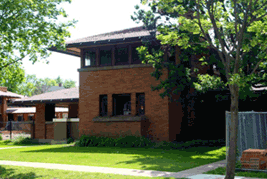
Between 1900 and 1917, his residential designs were considered "Prairie Houses", a style known for its horizontal lines, flat or low, sloping roofs with broad overhangs, windows in horizontal clusters, integration with the landscape, solid construction, and unfinished materials. He also had an affinity for traditional Japanese art and design, which made it's first appearance in his work with the Wescott House (built between 1907 and 1908), in Springfield, Ohio. Other notable structures of this period include the Avery Coonley House in Riverside, Illinois, and the Frederick C. Robie House in Chicago.
During the 1920's, he designed many innovative structures, beginning with Graycliff. The Graycliff estate was a complex design that incorporated three buildings and expansive grounds that featured cantilevered balconies, and a transparent "screen" of windows that allows views of the lake through Graycliff's largest building, the Isabelle R. Martin House. Perched atop Lake Erie, Wright's designs for Graycliff's grounds incorporated features that echo it's watery setting: a pond, a fountain, sunken gardens and stone walls in a waterfall pattern that surround the property. Always being one to add a unique touch to his work, Graycliff aligns with the setting sun on the Summer Solstice.  One of Wright's most famous private residences was constructed from 1935 to 1939 near Pittsburgh, Pennsylvania - Fallingwater. It was designed according to Wright's desire to place the occupants closer to natural surroundings, with a stream and waterfall running under part of the building. The buyers own engineers argued that the design was not sound, and though they were overruled by Wright, the contractor secretly added extra steel to the horizontal concrete elements. In 1994, the building was examined by Robert Silman and Associates, and a plan was developed to restore the structure. In the late 1990s, steel supports were added under the lowest cantilever until a detailed analysis could be done. In March 2002, post-tensioning of the lowest terrace was completed.
  Wright's most recognized masterpiece, The Solomon R. Guggenheim Museum, is a building that Wright worked on for over 15 years (19431959), and is one of the best known museums in New York City. The building rises as a off-white spiral from its site on Fifth Avenue, overlooking Central Park. The interior twists from the ground floor to the top of the building, with paintings displayed along the walls of the spiral and supplemented by viewing rooms along the way. Its unique central geometry was meant to allow visitors to experience Guggenheim's collection of "non-objective" paintings with ease by taking an elevator to the top level and then viewing artworks by walking down the slowly descending, central spiral ramp, which features a floor embedded with circular shapes and triangular light fixtures, complementing the geometric nature of the structure.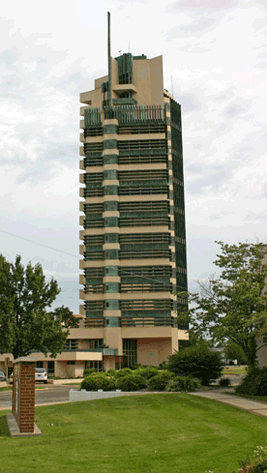
The Price Tower is a nineteen story, 221-foot high tower in Bartlesville, Oklahoma, and is also the inspiration for the Hexagon 12" tabletop globe. It is the only realized skyscraper by Wright, and is one of only two vertically-oriented Wright structures (the other is the S.C. Johnson Wax Research Tower in Racine, Wisconsin). It opened to the public in February 1956, and was occupied by the H.C. Price company until it was sold to Phillips Petroleum in 1981. In 2000, the building was donated to the Price Tower Arts Center, a museum of art, architecture, and design. Along with the Arts Center, the Inn at Price Tower, Copper Restaurant & Bar, and the Wright Place museum store are the current major tenants. In 2002, Pritzker Prize winning architect, Zaha Hadid was commissioned to design a museum expansion for the Price Tower Arts Center - a project that was included in the 2006 retrospective exhibition of Hadid's work at the Guggenheim Museum. On March 29, 2007, Price Tower was designated a National Historic Landmark by the United States Department of the Interior.
In addition to the many buildings and designs that he has left us, Frank Lloyd Wright's views on architectural space, ornamentation, relationship to site, concerning the place of architecture in art, life and philosophy have inspired generations of architects and artists all over the world, and for that we are a much better place. 